



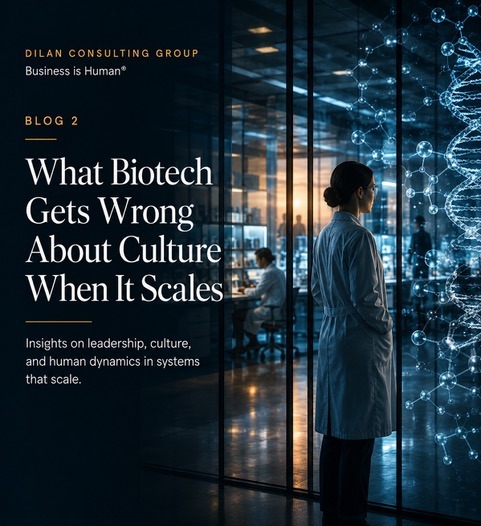
A field guide for science-led companies making their first — and most expensive — people mistakes
You built something extraordinary. The science is solid, the funding is real, and the team that got you here is brilliant. Then you hit Series B or C, the headcount triples in eighteen months, and something starts to go quietly wrong.
It’s not the science. It’s not the market. It’s the humans.
In the Bay Area biotech and biopharma landscape of 2026 — one of the most competitive, AI-accelerated, talent-driven environments in the world — culture failure is the silent killer that rarely makes the post-mortem. Companies don’t usually die because their science was weak. They stall, fracture, or hemorrhage talent because the human architecture never caught up to the scientific ambition.
I’ve spent more than thirty years inside organizations across nearly every sector — including a decade embedded with military contractors in defense, nuclear, and aerospace environments, nonprofit leadership, and fifteen years building DILAN Consulting Group. What these breakdowns look like from the inside, in science-led companies, follows a distinctive and recognizable pattern.
The Science-First Trap
Biotech companies are founded by people who are, understandably, in love with their work. The science is the mission. Everything else — operations, people management, team dynamics, organizational culture — can feel like overhead. Something to deal with when there’s more time.
There is never more time.
Steve Morris, CEO of newmedia.com and a long-standing life sciences advisor, has watched this dynamic play out repeatedly. “The biotechs that do get funded seem to be prematurely building out senior teams with big pharma pedigrees,” he told Cure. magazine. The result: organizations that are top-heavy with expectations that the infrastructure cannot yet support, and a culture clash between startup scrappiness and enterprise formality that no one has the language to name.
Meanwhile, the scientists and researchers who joined because they believed in the mission start to feel managed rather than engaged. And the leadership — promoted for scientific excellence rather than people skills — is often operating well outside its comfort zone without realizing it.
“Organizations don’t stall because of bad science. They stall because brilliant scientists were handed people problems and no one told them that was a different kind of problem entirely.”
— DILAN Consulting Group
The Promotion Pipeline Problem
In virtually every science-led organization I’ve worked with, the same story repeats: a brilliant individual contributor gets promoted into people leadership because they were the best scientist on the team. Not because they demonstrated curiosity about human dynamics, not because they had any training in feedback or conflict, but because they were excellent at what the organization was built on.
That’s not a hiring mistake. It’s a structural one. The organization rewarded the behavior it knew how to see — scientific achievement — and hoped the rest would follow.
It rarely does. Delegation becomes micromanagement. Feedback becomes critique. People stop bringing problems forward because the last time someone did, it didn’t go well. And the leader — often a deeply conscientious person — has no idea.
Research from the field of adult developmental psychology, most notably the work of Harvard’s Robert Kegan and Lisa Lahey in Immunity to Change, shows that leadership advancement often requires a fundamental shift in how a person makes meaning — from being driven by the expectations and frameworks of others, to developing what Kegan calls a self-authoring mind: an internal compass grounded in values, capable of holding complexity. Most technical leaders have never been invited into that developmental process.
Is Your Biotech Company Making These Culture Mistakes? Check What Applies:
- Your best scientists are now managing people with no formal leadership development.
- Team conflict is handled informally, inconsistently, or not at all.
- You can’t articulate your culture in behavioral terms — only aspirational ones.
- Onboarding focuses on technical orientation, not culture and values integration.
- Senior leaders rarely ask for feedback, and teams rarely give it.
- Key decisions are made in small groups, then announced rather than discussed.
- Attrition among high performers is higher than you’d expected at this stage.
- You’ve hired from pharma and the culture clash is visible but unnamed.
What Scaling Science-Led Culture Actually Requires
Culture in a biotech company cannot be an afterthought — a slide in an all-hands, a set of values on the website, or a ping-pong table in the break room. Culture is how people behave when they’re under pressure. And in a biotech company scaling through clinical trials, regulatory uncertainty, and investor scrutiny, pressure is the operating condition, not the exception.
What actually works is building the behavioral infrastructure of culture deliberately and early: making expectations explicit, building feedback into the rhythm of work rather than treating it as a special event, training leaders at every level in the actual skills of people leadership, and creating the psychological safety that allows problems to surface before they become crises.
Ron Heifetz of Harvard Kennedy School draws a critical distinction between technical problems and adaptive challenges. A technical problem has a known solution that experts can apply. An adaptive challenge requires people to change their values, beliefs, and behavior — and no authority figure can solve it for them. As Heifetz and Marty Linsky write in Leadership on the Line: “The single most common source of leadership failure we’ve been able to identify — in politics, community life, business, or the nonprofit sector — is that people, especially those in positions of authority, treat adaptive challenges as if they were technical problems.”
A culture problem in a scaling biotech company is always an adaptive challenge. Treating it like a technical one — by hiring a Chief People Officer, rolling out a new performance management system, or sending leaders to a weekend workshop — will produce compliance at best, cynicism at worst.
The Bay Area biotech companies that build enduring cultures share one characteristic: they treat the human system with the same rigor and investment they bring to the scientific one. People are not soft infrastructure. They are the infrastructure. Business is Human®.
References
Heifetz, R. A., & Linsky, M. (2002). Leadership on the line: Staying alive through the dangers of leading. Harvard Business School Press.
Kegan, R., & Lahey, L. L. (2009). Immunity to change: How to overcome it and unlock the potential in yourself and your organization. Harvard Business Press.
Morris, S. (2025, October). Quoted in: 7 threats to the survival of biotech startups in 2025. Cure. magazine.
Lifescience Dynamics. (2025, December). How small biotech startups can scale effectively.
 Download Your Free Ebook