Eugene’s Thoughts On Amazon

With the recent hubbub regarding the Amazon workplace, I’m genuinely thankful to Jeff Bezos and Amazon for inspiring a conversation about values and culture.

True or not, the alleged issues at Amazon are not surprising – and certainly not isolated. I personally see similar issues daily across all kinds of organizations, from start-ups to established enterprises and non-profits.

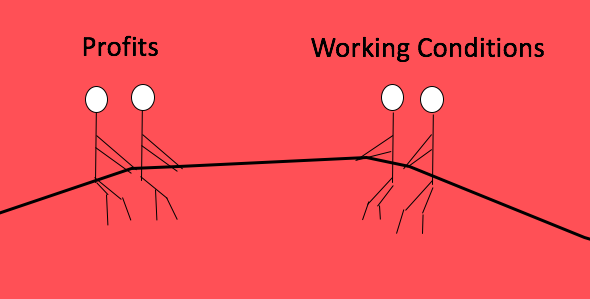
Companies genuinely struggle to meet competing demands. On the one hand, everyone wants increasing profits. Organizations are under pressure to do more with less and deliver short-term results. On the other hand, we are appalled to learn about companies with less-than-ideal (or worse) working conditions.

Sadly, the result of this conflict is a trend towards an “on-demand and on-call” workforce. While this issue is rife with complexity that cannot be addressed adequately in this short space, in my humble opinion, we — as a community and as leaders — need to step back and consider if it is even ethical. All too often “on-demand and on-call” leaves workers voiceless and vulnerable, working with no job security or predictable income.

The bottom line is that none of this is sustainable. So what’s the answer?  Leadership!

Leaders are the stewards of organizational values, which drive behaviors, and ultimately shape company culture. Today more than ever, companies need to develop leaders who walk the talk and are willing to buck the trends. Starting on day one, leaders need to realize that what they say or do – or fail to — has serious consequences.

Commonly these so-called soft conversations about values and organizational culture get put on the back burner – a conversation for another day when “we have more time or money.” And even if they do have the conversations, values may end up posted on the wall but not embedded in behavior.

Unfortunately, our experience at the Dilan Consulting Group is that these critical conversations often happen after a negative event — a mass exodus, lawsuit, bad PR. Only then do leaders finally stop and ask: “How did we get here? How do we make it better?” And usually these questions come with fingers pointing outward, when the reality is the leaders themselves have been shaping their organization’s culture all along whether or not they were conscious of it. Who they are and how they show up directed the personality of their organization, for better or worse.

Without mindfulness, even the best intentions can fall out of sync with values. Conversations about values and behaviors have to happen early and often because every action matters. Each decision creates lasting consequences that either build or erode gains.

Smart leaders start with culture in mind. They know that how they speak and behave, and the decisions they make, quietly create a picture that tells their employees what really matters.

It is never too late to start this conversation inside your organization. While shifting culture can be a slow process, you can reach critical mass faster if you proactively invest in developing your leaders and cultivating the values and behaviors that will lead towards sustainable, long-term success. The truth is that the competing demands highlighted above do not have to be mutually exclusive. It is possible to have great working conditions and consistently improve your bottom line. If this seems daunting, know you do not have to do it alone. We’re here to help.

Supercharging your Innovation Capabilities

Have you ever tried to build an innovative organization, or wondered how to make innovation happen?  If so, you’ll know it’s difficult because innovation is about releasing the potential in your leaders and teams. Unlike traditional management, the role of the innovation-driven leader is not to set the vision and motivate others to follow it. Instead, it’s to create a community willing and able to innovate. The challenge is to build an organization capable of innovating again and again.

INNOVATION versus INVENTION

Innovation is the introduction of something new or a better way of doing something that adds value. It is generally linked to positive changes in efficiency, productivity, quality, competitiveness, and market share. It differs from invention in that it uses a better but not necessarily new process, device, or method to generate novel ideas or processes with social impact, life-changing advances, and economic value. An invention, on the other hand, is a unique novel device, method, composition, or process. It is the creation of something that has never been made before and is recognized as the product of unique insight which extends the boundaries of human knowledge, experiences or capabilities. 

INNOVATION ENABLERS

Case studies confirm that an organization’s persistent dedication to innovation is what sets great companies apart. Findings also point to the complementary role of organizational culture and key enablers facilitating innovative thoughts into actions that improve organizational performance and gain market competitiveness. The following are some key enablers of innovation: 

Innovation Driven Leadership Within an innovating system, innovation driven leaders provide a source of inspiration that produces energy for seeking a challenging, exploring, and risk-taking. They also reinforce the right behaviors and correct the wrong one in their teams. They ensure that individuals at all levels are able to work effectively as a team member within and across functions. Innovation-driven leaders understand the innovative thinking methodology, how an innovating ecosystem works, and how to correct elements of their organization and culture that do not effectively support innovation. Such leaders expand and sustain organizational innovation capacity by drawing out the genius in each person and assemble them into innovations that represent a collective product. Most critically, innovation nurturing behaviors, build trust, and open communication, are comfortable taking risks and provide a sense of protection, safety and care. 

Organizational Culture And ValuesAn organization’s culture is the combination of spoken and unspoken rules that define how members should behave to be successful.  Some of the most important elements of culture that support innovation include trust, open communication, openness to and respect for people’s ideas, teamwork across functions, risk tolerance, technology support, recognition, and diversity of thinking styles and backgrounds.  Research shows culture enables people to innovate.  An innovative culture defines identity and market, and encourages the workforce to ask questions, share ideas, and engage in dialogue.  It strengthens an organization’s capability to collaborate and encourages research and experimentation through quick pursuit, evaluation, creative resolution, and adjustments.  Innovative culture also captures commitment and ensures organizational health, standards, stability, and adaptability. 

Collective Identity   Members of innovative organizations generally have the skills that allow them to accomplish their role in their innovating systems.  In such systems, interactions among members are critical for turning an idea into a process, product, and/or service.  Everyone applies innovative thinking to solve complex business problems they face.  As a collective, they are a community with a focused innovation strategy and a purpose for why the group exists.  Purpose makes people willing to take risks and do the hard work inherent in innovation.  As each team member applies innovative thinking to solve complex business problems faced by the organization, they not only contribute to the organization’s identity but also build the organization’s framework for innovation.  Hence, being a member of such an organization confirms purpose and creates meaning for work. 

People, Willingness, And Ability   If you’re trying to build an innovative organization, you must first understand only individuals and teams innovate.  Willingness among organizational members to innovate is necessary but not sufficient for innovation to flourish if the ability to do so is not there.  Organizational culture is a critical foundation for innovation and people’s willingness to innovate.  However, organizations, cultures, technology, and processes as independent entities do not innovate.  They support, facilitate or inhibit the people who desire to innovate.  Hence, it is critical for organizations to train their people to innovate, think about how to create value for customers, and understand that an organization’s future depends on innovation.

Preparedness   Innovation doesn’t come from organized plans.  It comes from stakeholders’ preparedness to address challenges and problems.  Training and development are thus fundamental to ensuring that leaders, managers, and individuals have the knowledge and skills necessary to innovate in the right place and at the right time.  To prepare and transform one self and others into creatively-innovating individuals, one needs to reduce individual innovation constraints by

  • Asking, watching, experimenting, learning, and trying
  • Treating idea generation as an exploration, not just a search
  • Learning to reformulate problems through problem-framing and problem-solving strategies.
  • Networking and answering four very basic human centered design questions: “What is?”  “What if?”  “What wows?”  “What works?
  • Accepting ambiguity and becoming risk tolerant

Organizational Agility Finally, agility is key in people-centric, innovative organizations. Simplified operations and an agile workforce are critical to an innovative ecosystem. Being an innovative organization requires well-thought-out organizational practices and strategies that stretch beyond just challenging the status quo and creating value. The entire organization, including the executives, human resources, finance, training and development, and information technology must be agile for it to become a forerunner of innovation in its industry. 

Now that you know what it takes to foster an innovative organization, you’re ready to start planting and nurturing innovation enablers without worrying about where to begin or how to build an innovative organization. 

Millennials In the Workplace: Not So Different After All

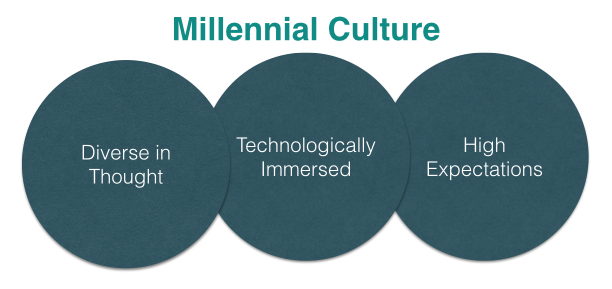
The millennial generation, unlike any before it, is receiving an unprecedented amount of media attention given the growing awareness that they will increasingly comprise a significant portion of the workforce over the next five to ten years. Despite the growing research touting how the generations are different and should be treated differently, have you ever wondered if they really are? If so, the results of the 2014 Millennial Impact Report by Achieve may help to shed some light because it highlights the attitudes about work culture, relationships and resources and their role across the work lifecycle (from hire to retention). 

However, if you have been reading the research on employee engagement or have read some recent bestselling business books, then you may have noticed that the so-called millennial differences are perhaps not so unique after all. We venture a little further in our hypothesis by proposing that the changes we are seeing are more a function of the now changed psychological contract between employers and employees. 

Gone are the days of climbing the corporate ladder on your way to a golden handshake. In their absence, today’s employees want continuous learning as a way to secure their futures. They are spending long hours at work with recent data from the Federal Reserve Economic Data Report (2013) confirming that Americans work more hours a week than any other industrialized nation. So while employees have come to accept that technology can blur the boundaries between personal life and work, they have also realized the value of meaningful relationships in the workplace as well as the importance of work that helps to make the world a better place. 

Furthermore, it is no coincidence that both of these factors probably also make the work itself and the continuous demands on their personal time a lot more tolerable or enjoyable. In other words, building deep relationships and contributing to “cause work” is likely a buffer against the stressors that might normally lead to decreased engagement, burnout or quitting a job. 

Let’s begin by taking a look at the idea of cause work and how the Achieve report says it plays an important role in hiring, retention and shaping culture. We believe all of this to be true. In addition, we propose that this is not a new idea. In his book Drive, Daniel Pink (2009) wrote about what he called the surprising truth about what motivates us. He explains that we are all motivated intrinsically toward autonomy, mastery and purpose. He further explains that “our deep-seated desire to direct our own lives, to extend and expand our abilities” is the new key to high performance. 

Similarly, Sirota (2005) in The Enthusiastic Employee introduced the Three Factor Theory of Employee Engagement, which describes the need for Equity, Achievement and Camaraderie in order to improve and maintain positive employee engagement. Specifically, the Achievement factor in his theory speaks to the need to take pride in one’s accomplishments by doing things that matter and doing them well. Even Christina Maslach and Michael Leiter as early as 1997 were writing about the importance of “meaningful and valued work” in The Truth About Burnout as a means to improve engagement and reduce stress. 

An additional finding from the Millennial Impact Report indicates that employees prefer to work with fellow employees as part of this cause work, which likely has an impact on engagement and decreases turnover. This echoes similar ideas proposed by Sirota (2005) who spoke of camaraderie, Pink (2009) who focused on “communities being unified around a common purpose” and Maslach and Leiter (1997) who discussed “a sense of community.” 

The bottom line is that we are not disagreeing that these are all important variables but that to say that they are strictly engagement indicators for the millennial generation might be a missed opportunity in that Benko and Anderson (2010) in The Corporate Lattice speak to an oncoming convergence of needs between the generations. And, indeed most of the research on engagement also echoes many of the other key findings of the Millennial Impact Report. 

In conclusion, the 2014 Millennial Impact Report adds great depth to our knowledge of what makes Millennial employees tick; however, we think it is an error to assume that it describes only the Millennial generation and believe this data is actually applicable across the spectrum to all employees signifying additional data in a shift in the psychological contract between employers and employees. Furthermore, we think this topic is only beginning to be understood and requires additional study in order to understand its long-term implications for how we work and live.

This article was first published in the APA Center for Organizational Excellence: Good Company Newsletter (August, 2014). 

How Do You Make Business More Human?

In today’s market, disruption of established business models lurks around every corner. That makes delivering a quality customer experience ― one that helps insulate a business from competitive threats and total disruption― bottom-line critical. As David Cooperstein, a digital marketing and strategy authority at Forrester, says, “The only sustainable competitive advantage is knowledge of and engagement with customers.”  As your customers become more connected and empowered, and traditional sources of competitive dominance wane, a holistic approach to customer experience is mission critical. But how do you achieve this?

I head up a Customer Experience Insights team for Wells Fargo Wholesale Banking – a group that serves big corporations, middle-market businesses, governments, and institutions with annual revenues of $20 million and more. Our Insights group is a hybrid of quantitative data analysts and qualitative design researchers. We integrate left- and right–brain approaches to provide insights into our customer’s goals, behaviors, and tasks. Yet we do more than churn out insights: We make our customers’ organizations more human by developing capabilities to thrive in a world exploding with change.    

These capabilities ― embracing a holistic mindset, creating shared understanding, and engaging in design-oriented problem solving ― are about seeing the whole, aligning the diverse perspectives, and visualizing the future. These elements are crucial to building human-centered organizations for today’s networked world.

Embracing a Holistic Mindset

Most businesses have an industrial-era hangover ― a mechanistic mindset that breaks functions, departments, and processes down into smaller parts to control complexity and maximize efficiency. This approach works best in stable, routine, predictable environments. We are no longer living in that world.

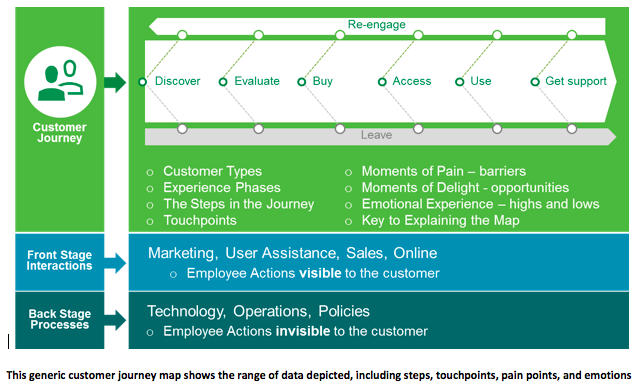
Organizations create positive customer experiences by aligning an organization’s strategy, technology, and execution process with customer expectations. A holistic mindset is critical to understanding both how things work and the underlying dynamics of why things work. Customer journey mapping, as my Insights team calls it, illuminates the particulars of the experience – its steps, phases, touchpoints, pain points, moments of delight, emotional experience – and its scope beyond the moment when the product or service overlaps with the customer’s life. Based on a synthesis of what people do, say, and feel, these customer journey maps reveal that the total customer experience is more than the sum of individual processes strung together across departments.

To differentiate on customer experience, organizations need both insight into the entire customer lifecycle and help connecting the dots between siloed organizational departments. Researchers tasked with mapping the customer’s journey find themselves leading organizational change just by bringing separate departments together to think about the end-to-end life cycle. 

Transformation to a holistic customer experience approach begins as the business reconciles its own internally held assumptions – embedded in its strategies, processes, and structure – with how customers experience results. What does it all add up to? What’s in and out of alignment with intentions? Where is friction in the system? Where are the opportunities?

 Creating Shared Understanding

The nature of work today is multifunctional – it takes product managers, designers, technologists and others to bring digital products to market. These teams come together to execute simple solutions for customers amid complexity, and each function represents a diverse viewpoint and focus that must be discussed, understood, and reconciled for alignment and collaboration to occur.

Being customer-centric invites and necessitates multifunctional conversations. Since the customer’s experience inevitably traverses organizational siloes and functional area boundaries, research initiatives tend to catalyze cross-group collaboration and become platforms where alignment conversations take place. Through dialogue, teams articulate answers to questions that are central to creating a holistic customer experience, such as “What problems are we trying to solve? Why? What will be easy? What will be harder?” 

Customer insights are most powerful in helping organizations learn and innovate when the what of lived experience combines and calibrates with the how of meeting business goals.

Engaging in Design-oriented Problem Solving

The power shift from business to people signals a need for organizations and their teams to transform how they work together and create value. User-centered design (UCD) is a product development process that supports customer centricity by incorporating iterative end-user feedback throughout the entire product life cycle.

The rise of UCD practices acknowledges that products and services need to work well for people who use them. In an experience-driven economy, UCD mitigates risk of an unsuccessful product by getting noise out of the system earlier. Design-oriented problem–solving is about recognizing that the future can’t be proven in advance. The only way to get to a successful solution is to prototype, gather feedback from real people, and refine. 

The Power of Customer Insights

To achieve Cooperstein’s vision sustainable competitive advantage ― knowledge of and engagement with customers ― companies must implement a holistic approach to customer experience. But this doesn’t just happen. It needs the customer’s voice to be heard companywide. That’s the role of Wells Fargo’s Customer Insights teams. As businesses, we can and should do so much more than collect data about people. We can catalyze our organizations to better understand the humans we serve, and in the process, make our businesses more human.

Employee Engagement – Beyond the Golden Rule

Understanding Engagement

The dictionary describes engagement as “the act of engaging or state of being engaged,” but the term is much more complicated in reality. Experts do not agree on what it means in the workplace, or how to achieve it. There is no one-size-fits-all solution, to be sure, but success can be achieved if one understands the currencies of engagement and moves beyond the

Golden Rule to the Platinum Rule.

Some define employee engagement as a state of mind where one feels satisfied, empowered and committed at work. Others suggest it is characterized by such behaviors as persistence and initiative. Still others describe it as innate personal characteristics, like the right attitude, level of energy or point of view. Some define engagement as a combination of all of these. But, confusion over definition cannot distract from the importance of engagement. There is widespread agreement that an engaged workforce leads to higher retention and productivity, lower stress, better customer satisfaction and ultimately results. The cost of not addressing engagement is tremendous. A 2013 Gallup report showed that 70 percent of workers are not engaged or actively disengaged, placing the annual estimated loss in U.S. business productivity at $450-$550 billion.

With so many models for how to improve engagement, which is the best one? Unfortunately, there is no one model for optimizing engagement because not all individuals or organizations are alike.

The 12 Currencies of Engagement

People are like nations—that is, they will accept some currencies, but not others. Even so, some currencies are universally accepted. Examining a cross section of the most popular and researched models shows 12 factors most consistently reported to correlate highly with engagement:

  1. Engaged leaders and managers and an organizational culture that is nurtured at the top levels.
  2. Trusted leadership developed by honoring commitments and doing what is right.
  3. Timely, honest and consistent two-way communication.
  4. Amiable relationships with immediate supervisors.
  5. Respectful, collegial relationships with coworkers who do great work.
  6. Fairness in compensation, workload and negotiations.
  7. Pride in an organization’s mission, products or accomplishments.
  8. Appropriate and challenging opportunities for learning and career growth.
  9. Rewards or recognition for achievements, however small.
  10. Ability to influence decisions and have some control over the way one’s work is done, scheduled and managed.
  11. Flexibility in work location or methods, among others.
  12. Accommodation of personal needs.

This list reflects the most powerful currencies for inspiring engagement. But how do you know which currency or combination of currencies will be most effective? By knowing your audience.

Moving from Gold to Platinum

When it comes to culture and engagement, most thinking stems from the Golden Rule: “Do unto others as you would have them do unto you.” This is a good start, but there is a better way. Leaders must strive for the Platinum Rule: “Do unto others as they would like done unto them.” In other words, don’t assume others want what you want. Treat them the way they prefer to be treated.

In applying the Platinum Rule, we need to embrace the fact that engagement is personal, must be customized and is an ongoing, iterative process highly influenced by fluid dynamics between leaders and followers. This leaves many leaders wondering if it is possible, or realistic, to achieve it. The answer is yes, if leaders prioritize and invest time in relationships and building leadership capabilities.

To build leadership capabilities, consider using Emotional Intelligence as the foundation. Leaders who understand themselves and regulate their own behavior generally are more attuned to what is happening with their people. Ultimately, the leader’s ability to consistently deliver the right currency at the right time determines his or her effectiveness at engagement.

The Platinum Rule begins with active listening. Effective leaders notice that their people constantly communicate their desires through words and deeds. They become attuned to the currencies used by their direct reports and quickly gain insight into how best to engage and keep them motivated. This is where the Golden Rule provides a useful signpost; they probably behave toward others the way they wish to be treated. This method of assessing needs and wants also works up and across the chain of command.

Another approach, so simple that it is often overlooked, is asking people directly. In 2005, Sirota coined the term, “stay interview” to describe an ongoing, informal dialogue where one seeks feedback on the reasons why employees stay, matters that are going well or not and one’s performance as a leader. The goal is to stay connected. The 12 engagement factors can help, but it is essential to recognize that leadership behaviors are meant to drive and shape organizational culture.

Everything a leader does and says, consciously or unconsciously, models what is acceptable or unacceptable. It influences the choices one makes regarding strategy, structure, polices, procedures and their hiring and reward decisions. In short, employee engagement is not a one-shot effort to check off. It is a concerted effort to develop a partnering culture. Once you have learned what currency people want, you need to identify how frequently they want it.

An investment in your people will not go unrewarded. If nothing else, time spent getting to know them will communicate one’s genuine interest in them as fellow human beings, which itself goes a long way toward developing engagement. 

Human Resources (HR): It’s Time To Be a Strategic Partner

In today’s global economy there is an urgency to re-skill HR and develop high-impact HR professionals who are savvy business consultants and experts in HR practices and disciplines.  With advances in technology and availability of outsourcing and shared services centers, transactional HR work can be performed more efficiently so that HR can devote time to adding value inside the business.  However, getting some HR professionals out of their comfort zone (transactional work) will require more than an effort to divorce them from familiar work.  They will need to expand their critical thinking skills and gain a thorough understanding of the organization’s business, its strategies, the culture of the workforce, and the required leadership competencies that will differentiate it from the competition.

ROLE OF AN EFFECTIVE STRATEGIC BUSINESS PARTNER

Progressive companies with transformed HR departments are filled with specialists who are strategic consultants and HR experts.  They understand assessment, coaching, recruiting, succession planning, data analytics, I/O psychology, organization development, training, and technology.  These experts are the architects of the corporate talent system and work to strategically align talent management with organizational performance.  They understand workforce demographics and global culture; innovation; and strategies in recruiting, learning, social networking, and analytics.  They design new models for coaching, talent mobility, and performance management specific for business success.  Also, they know how the business works, makes money, and builds its competitive advantage.  Business leaders and employees trust them to solve organizational performance problems and make complex human capital (HC) management decisions that are often highly uncertain and context specific.  

COMPETENCIES THAT ARE NEEDED

To be valued as an effective “strategic” business partner, HR must:

  •  understand the business impact by asking the right questions to support business results;
  • be an organizational designer who comprehends the way the business is managed and aligns customer needs, business strategy, and organizational objectives, processes, systems and structures;
  • know the flow of revenue;
  • work with managers in talent management, employee engagement, and diversity;
  • guide executives in leadership development and succession planning;
  • think and act as performance advisors to the business;
  • use evidence-based workforce analytics to close gaps between talent and business strategy;
  • turn HR data into business metrics linked with positive market performance for business decision making and predictions; and
  • be an effective systems thinker who would know whether a business strategy can be implemented.

Also, in order to release human potential, empower leaders to challenge the status quo, imagine the future, and leverage efficiency to achieve greater effectiveness, HR must be skilled at:

  • Strategic visioning and imagination;
  • Proactive questioning and active listening;
  • Creative problem solving;
  • Agility and speed;
  • Resilience;
  • Engagement and collaborations with peers from multiple cultures;
  • Cross-cultural employee engagement;
  • Mastery of advances in technology and analytics;
  • Data-based decision making; and
  • The art of storytelling.

CRITICAL ROLE OF THE CHIEF HUMAN RESOURCES OFFICER (CHRO)

While the role of CHROs once centered on stewardship for essential administrative HR functions, it is now transforming into a role of chief strategist.  Today’s CHROs have multidimensional responsibilities, from regulatory compliance and corporate governance overseers to organizational strategists and enterprise business leaders.  CHROs are much more involved in shaping the business strategy, not just supporting and implementing it.  They possess skills and competencies that extend beyond HR, and demonstrate an understanding of the entire business.  They are positioned as C-level strategic business partners who contribute to business strategy, translate enterprise strategy into global workforce requirements, forecast talent needs, address talent gaps, and orchestrate learning skills and career development.  CHROs typically report to the chief executive officer or the chief operations officer, and HR directors may report to them.  Since they typically direct HR functions, they play a critical role to the successful transformation of HR being an effective strategic business partner. 

The CHRO must run basic HR well first before HR can help senior executives develop and reinforce the behaviors that drive business success.  This means hiring, onboarding, training, payroll, labor relations, benefits, and all of the other administrative functions must be efficient, effective, and compliant.  Second, the CHRO must deliver a talent view into the future and prepare the business for future skills gaps, labor market opportunities, and impacts of potential mergers and acquisitions.  Third, the CHRO is the keeper of culture and must monitor the organization’s health, providing feedback and offering advice to the chief executive and the executive team when things have change.  Finally, since the challenges and solutions now available in HR span the entire business and have the potential to create significant competitive advantage, the CHRO must continuously up-skill the HR team and grow their confidence as strategic business consultants.  This means ensuring the HR team is skilled in the power of talent analytics, decision science, and changing technologies for business operations. In addition, it means supporting innovation and creativity so that high-impact HR tools, programs and practices are developed, tested, and implemented to ensure future business success.

In a transformed HR environment, the CHRO is the chief HR and people officer, change officer, and culture officer.  CHROs are themselves tightly aligned with the business and will push for innovative HR solutions that are company-specific. They use unique programs to leverage the business’s unique culture, business strategy, workforce demographics, and people strategy.  Under their leadership, HR aligns HC strategies with business strategies, develops capabilities to deliver organization informatics using HR data, focuses on workforce effectiveness, and makes talent management a real priority.

Contact Form

  • This field is for validation purposes and should be left unchanged.

DILAN Delivers - Legal Disclaimer

By submitting a challenge or problem to DILANdelivers@dilanstg.wpengine.com, you grant DILAN Consulting Group permission to publish it on our websites, newsletter and social media platforms. Your full name and contact details will never be included or distributed. The advice received is expressing personal opinions and views and the advice offered is intended for informational purposes only. Use of this column is not intended to replace or substitute for any professional advice.

This column, its authors and DILAN Consulting Group are not responsible for the outcome or results of following any advice in any given situation. You, and only you, are completely responsible for your actions.

DILAN Consulting Group reserves the right to edit problems/questions for length and clarity and offers no guarantee that any particular question will be published.