
What the research says about accountability, and what leaders can do instead
Prepared by the DILAN Team
In March 2026, Gallup published a finding that should give most leadership teams pause. Of seven core leadership competencies, creating accountability came out as the weakest. In an August 2025 survey of more than 23,000 people, 46% of leaders rated themselves outstanding or exceptional at it. Only 30% of managers gave their own leaders that rating.
That gap is familiar to us. Most leaders we work with believe they're clear about expectations. Many of the people who report to them aren't so sure.
Gallup's research on employee engagement points the same way. In 2024, just 46% of U.S. employees clearly knew what was expected of them at work, down from 56% in March 2020.
So when a leader tells us, "My team needs to take more ownership," we usually start with a different question.
Have we made ownership possible?
Pressure Doesn't Create Ownership
When someone isn't following through, the instinct is to push. Set a firmer deadline. Say it louder. Tell them to own it.
In our experience, that rarely works.
In The Oz Principle, Roger Connors, Tom Smith, and Craig Hickman described a distinction between taking responsibility for results and explaining them away. A widely used tool called the Accountability Ladder builds on that idea, and we use our own version of it with clients.
Its lower rungs, blaming others, making excuses, feeling powerless, and waiting to be told, reflect responses that can protect people from perceived threats or consequences. Pressure can reinforce those responses rather than move people toward ownership.
The research helps explain why.
In their influential review, psychologists Jennifer Lerner and Philip Tetlock found that accountability influences judgment differently depending on the circumstances. When people know what their audience wants to hear, they may shift toward that position. When they must defend a decision, they've already made, they may become more committed to it.
In other words, accountability can improve thinking, but it can also encourage defensiveness and justification.
The distinction matters for leaders. Holding someone accountable isn't simply about increasing pressure. It's about creating expectations, conversations, and working relationships that encourage people to take responsibility for outcomes.
That's why effective leadership development needs to address more than performance standards. Leaders also need to understand how their behavior influences the way employees respond to those standards.
Safety and Standards Aren't Opposites
Some leaders worry that a focus on psychological safety will make their teams soft. If employees feel too comfortable, will they still push themselves to perform?
Amy Edmondson and Michaela Kerrissey challenged this assumption in their 2025 Harvard Business Review article, What People Get Wrong About Psychological Safety.
Their argument is that psychological safety doesn't mean avoiding difficult conversations, lowering expectations, or protecting people from consequences. It means creating an environment where people can speak candidly, acknowledge mistakes, challenge assumptions, and ask for help without fear of humiliation.
High standards and psychological safety are not competing priorities. Effective teams need both.
Consider two managers responding to a missed deadline.
One asks, "Why didn't you take ownership of this?"
The other asks, "We agreed this would be finished Friday. What got in the way, and what needs to change so we meet the next deadline?"
Both managers are addressing performance. But the second creates an opportunity to understand what happened, identify the employee's responsibility, and agree on a better outcome.
This doesn't mean eliminating consequences. It means making accountability a constructive conversation rather than an exercise in assigning blame.
Building that kind of environment is also an important part of developing high-performing teams. People need to know what's expected of them, feel comfortable raising concerns, and trust that performance standards will be applied consistently.
Three Things to Try This Week
Accountability doesn't improve because a leader announces that everyone needs to take more ownership. It improves through specific, consistent leadership behaviors.
Here are three places to start.
- Get clear first.
In his Harvard Business Review article, The Right Way to Hold People Accountable, Peter Bregman identifies several conditions leaders should examine before holding someone accountable: expectations, capability, measurement, feedback, and consequences.If any one of those is unclear, start there.
Before assuming someone isn't taking ownership, ask whether they understand the expected outcome, have the authority and resources to deliver it, and know how success will be measured.
- Let them go first.
In an accountability conversation, try asking, "How do you think that went?" before sharing your own assessment.Then listen.
When people recognize a performance gap themselves, they have an opportunity to take responsibility for addressing it. When leaders immediately provide the diagnosis and solution, they may unintentionally take that responsibility away.
This doesn't mean withholding feedback. It means giving the employee an opportunity to demonstrate ownership before you step in.
- Describe behavior, not character.
Compare these two statements:"The report arrived after the meeting started, and we made decisions without current numbers."
"You're unreliable."
The first describes an observable behavior and its business consequences. The second makes a judgment about the person.
One opens the door to a productive discussion. The other invites a defense.
Leaders who want more accountability should focus on what happened, why it matters, and what needs to change.
Ownership Starts With Leadership
When accountability is weak, it's tempting to focus on the employees who aren't delivering.
But leaders also need to examine the conditions they've created.
Are expectations clear? Do people have the authority to make decisions? Can they raise concerns without being punished for speaking up? Do managers provide timely feedback, or does accountability only become a topic when something goes wrong?
These questions are especially important when organizations are working to strengthen employee engagement and retention. Employees are more likely to take responsibility for outcomes when they understand how their work contributes to the organization and experience consistent, credible leadership.
At DILAN Consulting Group, we believe accountability is both an individual responsibility and a leadership responsibility.
You cannot take ownership for someone else. But you can create the conditions that make ownership more likely.
And that's a much better place to start than telling people to "just take ownership."
Read the Full Guide: Accountability and Ownership at Work
We've developed a free two-part guide, Accountability and Ownership at Work, to help individuals and leaders put these ideas into practice.
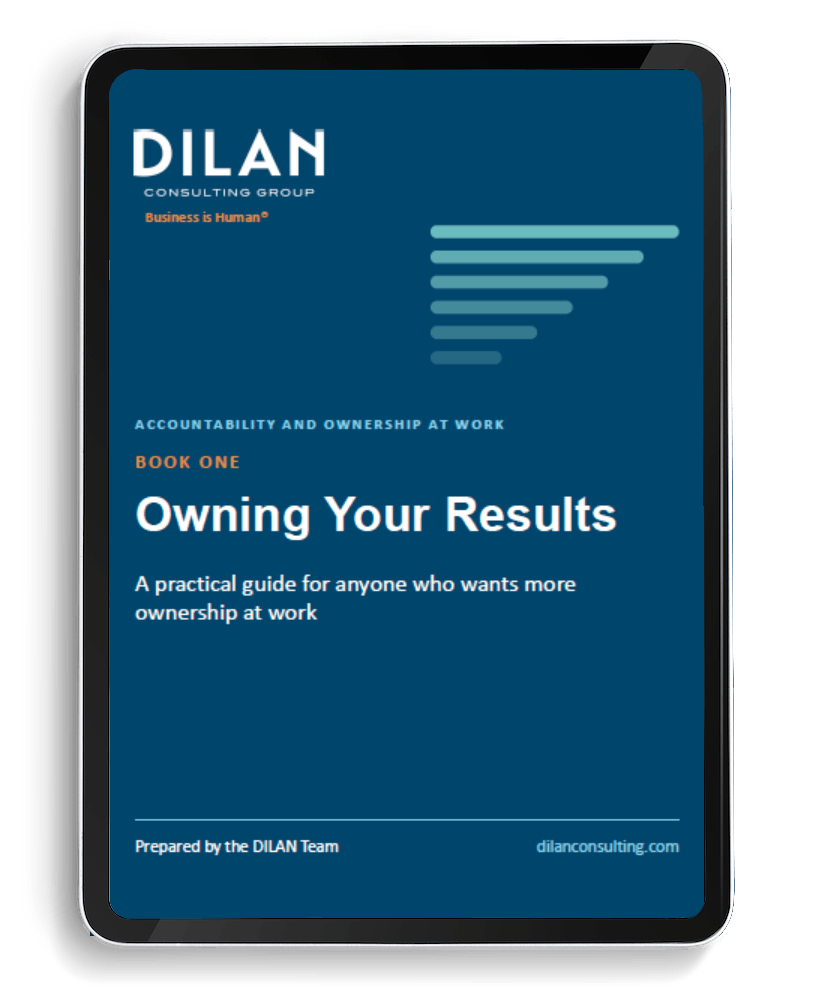
Book One: Owning Your Results
For anyone who wants to take greater ownership of their work. Explore the psychology of ownership, the Accountability Ladder, and a practical self-check to help identify opportunities for improvement.
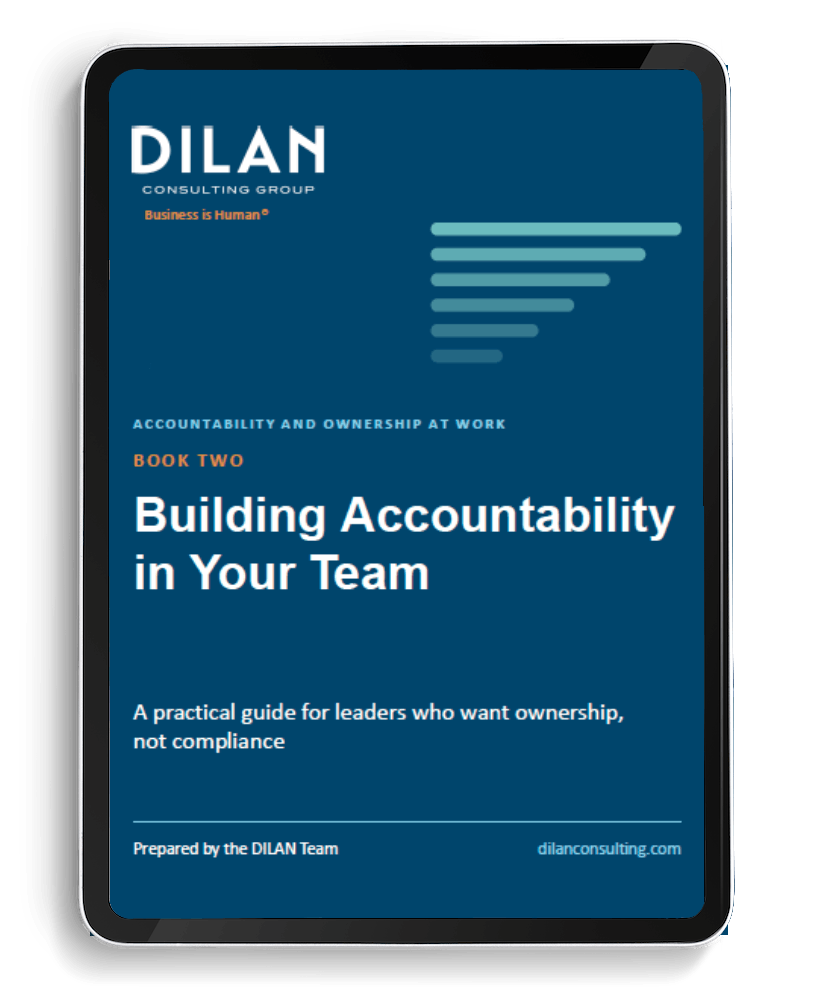
Book Two: Building Accountability in Your Team
For leaders who want to strengthen accountability across their teams. Learn about the conditions, conversations, and management practices that encourage ownership, with a leader self-check and a practical 90-day plan.
References:
Bregman, P. (2016, January 11). The right way to hold people accountable. Harvard Business Review.
Connors, R., Smith, T., & Hickman, C. (1994). The Oz principle: Getting results through individual and organizational accountability. Prentice Hall.
Edmondson, A. C., & Kerrissey, M. J. (2025). What people get wrong about psychological safety. Harvard Business Review, 103(3), 52–59.
Harter, J. (2025, January 13). U.S. employee engagement sinks to 10-year low. Gallup.
Harter, J., & Tatel, C. (2026, March 19). Accountability is leadership's greatest weakness. Gallup.
Lerner, J. S., & Tetlock, P. E. (1999). Accounting for the effects of accountability. Psychological Bulletin, 125(2), 255–275.